
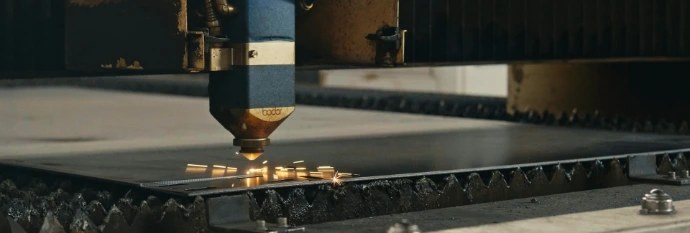
On thin sheet metal, a good laser cut edge is square to the face, has fine, even lines running down it, and carries little or no dross stuck to the underside. On mild steel cut with oxygen, it'll also have a thin dark oxide skin, which is normal.
Whether that edge is good enough depends on what happens next. An edge that's perfect for a hidden bracket might need cleaning before powder coating, and an edge that's fine to weld might be too sharp for a part people handle every day. This post explains what you're looking at on a laser-cut edge, what changes it, and how to ask for the edge your part actually needs.
What you'll see on a laser-cut edge
Pick up a laser-cut part and look closely at the cut face. You'll usually notice a few things.
Striations. Fine vertical lines running down the edge, a bit like a record groove turned on its side. They come from the way the melt is blown out as the beam moves. On thin sheet they're barely visible; on thicker plate they get coarser, especially towards the bottom of the cut.
Dross. Small beads or a ridge of re-solidified metal clinging to the bottom edge. Molten metal that wasn't blown clear froze before it left. A little is normal on thicker material; a lot means the settings were off or the material was difficult.
Burr. A sharp lip on the bottom edge. It's often what's left after dross is knocked off, and it's the bit that cuts fingers.
Oxide or discolouration. On mild steel cut with oxygen, a thin dark grey or blue-black layer on the cut face. On stainless and aluminium cut with nitrogen, the edge is usually bright, though thicker stainless can show some heat tint near the edge.
Squareness. A laser cut on thin sheet is close to square through the thickness. On thicker plate there can be a slight taper. Thermal cutting standards such as ISO 9013 classify cut quality by how square and how smooth the edge is.
Oxygen vs nitrogen: the biggest factor you'll notice
The assist gas blown through the nozzle has more effect on how the edge looks than anything else.
| Oxygen-assisted cutting | Nitrogen-assisted cutting | |
|---|---|---|
| Typical use | Mild steel, especially thicker plate | Stainless steel, aluminium, and mild steel when a clean edge matters |
| Edge colour | Dark oxide layer | Bright, oxide-free |
| Effect on coating | Oxide can affect paint and powder adhesion; often cleaned first | Generally ready for coating after deburring |
| Effect on welding | Usually welds fine; heavy oxide is often cleaned off for best results | Clean metal at the joint |
| Speed on thick mild steel | Faster, because oxygen adds heat to the cut | Slower on thick plate |
Oxygen reacts with hot steel and adds energy to the cut, which is why it's the common choice for thicker mild steel. The trade-off is the oxide skin. Nitrogen doesn't react, so it just blows the melt out and leaves clean metal behind. That's why stainless and aluminium, where looks and corrosion resistance matter, are normally cut with nitrogen.
What else affects edge quality
Thickness. Thin sheet gives the cleanest edges. As thickness goes up, striations get deeper, dross becomes more likely, and squareness drops off.
Material. Mild steel cuts very cleanly with oxygen. Stainless cuts well with nitrogen but holds heat, so thick stainless can carry more dross. Aluminium conducts heat away fast and can leave a slightly rougher underside.
Sheet condition. Rust, mill scale, oil, and pitting on the sheet surface all show up in the cut. A clean, flat sheet gives a better edge than a scaly one.
Part geometry. Sharp corners, tiny holes, and narrow webs concentrate heat. Edges around those features are more likely to show dross or slight burning. Our post on minimum hole size for laser cutting covers the starting rules.
Process. Compared with plasma, laser leaves a narrower heat-affected zone and less bevel, so the edge is cleaner from the start. The comparison of laser cutting vs plasma cutting goes into the detail.
Is the edge ready for powder coating?
This is the question that matters most for visible parts. Powder coating relies on clean, well-prepared metal, and edges are the weakest point on any coated part.
Two things work against a raw laser-cut edge. Sharp edges let the powder pull thin as it cures, so the coating on the very corner is thinner than on the flat face. And the oxide on an oxygen-cut mild steel edge can affect adhesion, so it's often cleaned off before coating.
That's why coated parts usually go through some edge preparation first: deburring to remove sharp lips and dross, and cleaning to remove oxide where needed. Our guide to deburring sheet metal covers the options, and what powder coating is explains why prep does most of the corrosion work.
How to ask for the edge you need
Most drawings don't mention edges at all, and most of the time that's fine. But if the edge matters, say so. Useful notes include:
- "Break all sharp edges" or "deburr all edges" for parts people will handle.
- "Visible face: side A" so the cleaner side faces outward.
- "Edges to be coated" so oxide removal is planned in.
- "Oxide-free edge required" if the edge will be welded to a critical standard or left bare.
Formal edge quality classes exist under ISO 9013, but for most sheet metal parts a plain-language note works better and costs less to check.
Getting parts cut and finished
Send the drawing with the material, thickness, quantity, and any notes about the edge or the visible face. Our laser cutting service handles the cut, and metal finishing and powder coating can go on the same order.
Start a quote for laser cutting and mention how the part will be finished.