
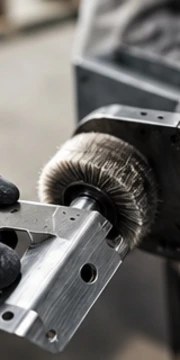
Deburring is the job of knocking off the sharp lips, slivers, and slag that cutting, punching, and drilling leave on sheet metal edges. It makes parts safe to handle, helps them fit together, and gives coatings a fair chance of covering the edge.
Not every part needs it. A laser-cut bracket hidden inside a machine may be fine as cut. A cover panel that someone will grab every day, or an outdoor part that's going to be powder coated, is a different story. This guide covers where burrs come from, the main ways to remove them, and how to say what you want on a drawing so you get it without paying for more than you need.
What a burr actually is
A burr is a small ridge of metal pushed or dragged past the edge during cutting. It can be a thin, razor-like lip, a ragged flap, or a bead of re-solidified metal stuck to the underside. Run a finger along a freshly sheared edge (carefully) and you'll feel it immediately.
Different processes leave different kinds of edge:
| Process | Typical edge condition | How much finishing it usually needs |
|---|---|---|
| Fibre laser cutting | Clean face; sometimes small dross on the bottom edge, sharp corners | Light, often just breaking sharp edges |
| Plasma cutting | Wider kerf, bevel, and heavier dross on the underside | More grinding |
| Guillotine shearing | Rolled-over edge on one side and a burr on the other | Light to moderate |
| Punching | Burr on the die side of every hole | Light, on each hole |
| Drilling | Burr on the exit side, sometimes both sides | Light, per hole |
| Sawing | Rough edge and burr | Moderate |
Laser cutting is usually the cleanest of these, but thicker material and some cutting conditions leave dross, a small bead of slag on the bottom edge. Our post on laser cut edge quality explains what affects it and what's normal.
When deburring really matters
Handling and safety
Sharp sheet metal edges cut skin. Anything that will be handled regularly, installed by hand, or used around the public should have its edges broken. Think enclosure doors, shelf brackets, machine guards, and furniture parts.
Fit and assembly
A burr on a hole can stop a bolt seating flat or a pin going in. A burr along an edge can hold two parts apart, so a tab doesn't sit fully in its slot. On a tight assembly, a few tenths of a millimetre of burr is enough to cause trouble.
Coating
This is the one people underestimate. When powder coating melts in the oven, surface tension pulls it away from sharp corners, so the film is thinnest right on the edge. A sharp, unbroken edge can end up with very little coating, and that's where rust starts on an outdoor part. Rounding the edge gives the powder something to hold on to. Some coating guidelines for corrosive environments call for edges rounded to about a 2 mm radius before coating; for general work, simply breaking the sharp edge helps.
Laser-cut mild steel cut with oxygen also carries a thin oxide layer on the cut face, which can affect adhesion. Edges are often cleaned before coating for that reason. Our guide to what powder coating is covers the rest of the preparation.
Welding and bending
Burrs and dross on weld edges can trap contamination and upset fit-up. On bends, a burr on the outside of the bend line can crack or leave a mark. Neither is usually a big problem, but they're reasons to clean edges before the next step rather than after.
How sheet metal is deburred
There are four broad approaches, and a typical shop uses more than one.
| Method | How it works | Best for | Limitations |
|---|---|---|---|
| Hand tools | Files, scrapers, countersink and swivel-blade deburring tools | One-offs, holes, awkward spots | Slow, results vary by person |
| Grinding and linishing | Angle grinders, flap discs, belt linishers | Heavy dross, thick plate, weld prep | Can leave scratches and heat marks; hard on thin sheet |
| Brushing and edge rounding machines | Parts pass under abrasive brushes or belts | Batches of flat laser-cut parts | Need a flat part; less suited to formed shapes |
| Tumbling and vibratory finishing | Parts tumble in a bowl with abrasive media | Many small parts at once | Can mark faces; not for large or delicate parts |
Most flat laser-cut parts are deburred before bending, while they're still flat. Once a part has flanges and returns, it's much harder to reach every edge evenly.
How to specify deburring on a drawing
Vague notes cost money, because whoever's quoting has to guess. Be specific about what you need.
- "Break all sharp edges" is a common general note. It means remove burrs and take the sharpness off, without a defined size.
- "Deburr all edges and holes" makes it clear that holes are included too.
- A chamfer or radius size, such as "all edges 0.5 mm × 45°" or "edge radius 2 mm min", gives a measurable result. Use it where the edge matters for coating or fit.
- "Deburr show face only" or a note on specific edges keeps cost down when only part of the edge is visible.
If an edge must be left sharp, for example for a scraping blade or a precise mating edge, note that too. Otherwise someone may helpfully round it off.
Deciding how much finishing you need
A rough guide:
- Hidden structural part, not coated: usually as cut, perhaps with dross removed.
- Handled part, not coated: break all sharp edges.
- Indoor part to be powder coated: break edges and clean oxide where needed.
- Outdoor or coastal part to be coated: round edges to a defined radius, especially exposed outer edges.
- Decorative or visible part: specify which faces and edges must be blemish-free.
Deburring is one part of a wider set of finishing operations. Our overview of types of metal finishing explains how it fits with brushing, blasting, polishing, and coating.
Getting parts deburred
Put the edge requirement on your drawing or in the quote notes: which parts, which edges, and what result you need. Our metal finishing service covers parts we make and parts you send in that we didn't make. Start a metal finishing quote and add cutting, bending, or powder coating to the same order if you need them.