
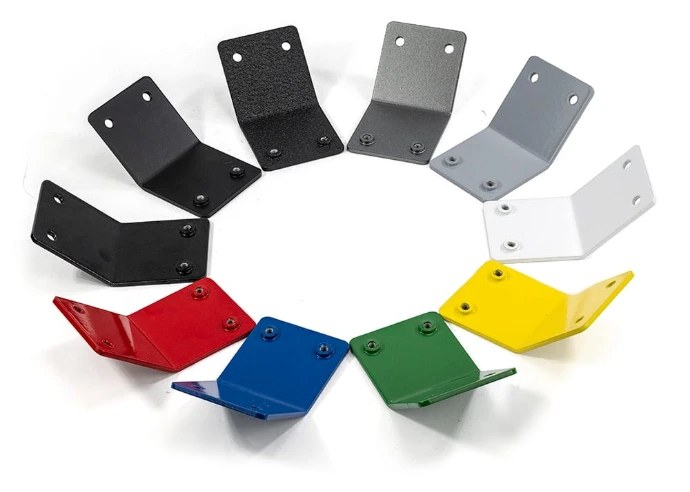
A powder coat starts life as a dry powder, not a liquid paint. It's sprayed onto bare, clean metal using static electricity, then baked in an oven until it melts and cures into a tough, even film.
That's why it's the default finish on so many gates, brackets, enclosures, and furniture frames. It goes on thicker than wet paint, it doesn't run or sag, and there's no solvent to evaporate. It does have limits, though: it needs an oven, it builds up in holes and threads, and it's only as durable as the preparation underneath. Here's how the process works and what that means for your parts.
How powder coating works, step by step
Every coater's line is different, but the process follows the same basic sequence.
- Preparation. The part is cleaned of oil, grease, rust, and mill scale. Depending on the coater and the job, that might be chemical washing, a conversion coating, abrasive blasting, or a combination. Laser-cut edges with an oxide layer are usually cleaned too, because oxide can hurt adhesion.
- Masking. Threads, bores, earth points, and anything else that must stay bare are plugged or taped.
- Hanging and earthing. The part is hung on a rack and electrically earthed. That earth connection is what makes the next step work.
- Spraying. A spray gun gives the powder particles an electrostatic charge. They're attracted to the earthed part and cling to it, wrapping around edges and onto the back faces.
- Curing. The part goes into an oven. A typical cure is around 160 to 200 °C metal temperature for roughly 10 to 20 minutes, depending on the powder. The powder melts, flows into a continuous film, and chemically cross-links.
- Cooling and inspection. Once cool, the coating is fully hard. There's no drying time like there is with paint.
Powder types: polyester, epoxy, and hybrid
The powder itself comes in a few chemistries. For most sheet metal work, you'll only need to know three.
| Powder type | Strengths | Weakness | Typical use |
|---|---|---|---|
| Polyester | Good UV and weather resistance, holds colour outdoors | Less chemical resistance than epoxy | Gates, balustrades, outdoor enclosures, signage |
| Epoxy | Very hard, good chemical and corrosion resistance | Chalks and fades in sunlight | Indoor equipment, primers, parts in chemical areas |
| Epoxy-polyester hybrid | Good all-rounder indoors, smooth finish | Not for prolonged sun exposure | Indoor furniture, shelving, appliance parts |
If the part will see sunlight, the topcoat should be polyester. Epoxy is excellent, but left outside it chalks: the surface goes powdery and the colour fades.
For harsh environments, coaters can apply a primer layer under the topcoat. That builds total thickness and adds corrosion protection, especially on edges.
How thick is powder coating?
A typical single coat is about 60 to 80 µm, with a normal range of roughly 50 to 100 µm. A primer plus topcoat system often lands between 100 and 200 µm.
That's noticeably thicker than a coat of wet paint, and it matters for fit. A 60 to 80 µm coat on each face of a hole shrinks the diameter by around 0.12 to 0.16 mm. On an M8 clearance hole that's nothing. On a threaded hole, a bearing bore, or a tab that slots into another coated part, it can be the difference between fitting and not fitting.
The answer is masking, or designing with enough clearance. Our post on masking for powder coating covers what to mask and how to mark it on your drawing.
What powder coating is good at, and where it struggles
It's good at:
- Durability. A cured powder film is hard and resists chipping and abrasion better than most single-coat wet paints.
- Even coverage on flat and gently curved surfaces, without runs or drips.
- Colour choice. Powders are made across the standard RAL colour range and beyond, in gloss, satin, matt, and textured finishes.
- Low solvent emissions. Powders contain no solvent, so the process gives off negligible volatile organic compounds, and overspray can be reclaimed.
It struggles with:
- Deep recesses and tight inside corners. Charged powder tends to collect on the edges of a recess and struggles to get into the back of it. Coaters call this the Faraday cage effect. Narrow channels, deep boxes, and tight internal corners can end up with thin coverage.
- Sharp edges. As the powder melts, surface tension pulls it away from sharp corners, leaving the film thinnest exactly where it's most exposed. Rounding or deburring edges before coating helps a lot. See our guide to deburring sheet metal.
- Heat-sensitive parts. Anything with rubber seals, plastic, electronics, or adhesives can't go through the oven. Coat the metal first and assemble afterwards.
- Touch-ups. Small damage can be touched up with paint, but it won't match the original perfectly. Big damage usually means stripping and recoating.
Designing parts that coat well
A few habits make a real difference to the finished part:
- Do all cutting, drilling, and welding before coating. A hole drilled afterwards is bare steel waiting to rust.
- Round or break sharp edges where corrosion matters.
- Add a hanging point if the part has no natural hole to hang it from, or say where a hook mark is acceptable.
- Avoid closed, sealed sections that trap air or liquid, and give tubes and boxes somewhere to vent and drain.
- Mark every no-coat area clearly on the drawing.
If you're weighing powder against a wet spray finish, our comparison of powder coating vs painting goes through the trade-offs.
Getting parts powder coated
We coat parts we make and parts you send in. To quote, we need:
- The material: mild steel, stainless, aluminium, 3CR12, or galvanised
- Rough size and quantity, or drawings
- The colour, by RAL code, name, or a photo of what you want to match, plus gloss level and texture
- Any areas to mask
- Where the part will be used: indoors, outdoors, or at the coast
We confirm the colour with you before coating. If you need help picking one, our guide to choosing a powder coating colour explains RAL codes and gloss levels. Find out more about our powder coating service, or start a powder coating quote.