
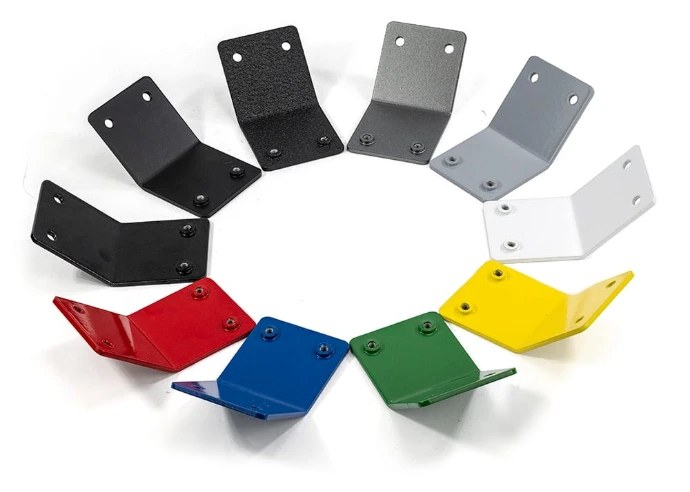
If your part is metal, can come off site, and fits in a coating oven, powder coating will usually outlast a wet paint job and look more even doing it. Paint is the better tool when the steel is already installed, too big to move, mixed with heat-sensitive materials, or needs regular touch-ups.
The question usually comes up when you're finishing gates, brackets, enclosures, or frames, and the honest answer is that both have a place. Pick wrong and you either pay for a finish that can't be repaired on site, or you repaint every couple of years. Below we compare them side by side, then go through the situations where each one clearly wins.
The side-by-side comparison
| Powder coating | Wet paint (spray or brush) | |
|---|---|---|
| How it's applied | Dry powder sprayed electrostatically, then oven cured | Liquid sprayed, brushed, or rolled; air dries or force dries |
| Typical film per coat | About 60–80 µm in one coat | Usually thinner per coat; builds up with several coats |
| Toughness | Hard, chip- and abrasion-resistant | Varies widely with the paint system |
| Runs and sags | None | Possible, especially on vertical faces |
| Edges and recesses | Thin on sharp edges; deep recesses are hard | Brush can reach most places; edges still thin |
| Needs an oven? | Yes | No |
| Works on site? | No | Yes |
| Heat-sensitive parts | No (rubber, plastic, electronics must come off) | Yes |
| Touch-up | Possible with paint, never a perfect match | Easy |
| Solvent emissions | Negligible | Solvent-based paints release VOCs |
| Ready to handle | Once cool | After drying time |
The short version: powder is the better factory finish, paint is the better field finish.
Where powder coating wins
Durability on handled parts
Anything that gets knocked, scraped, or touched daily favours powder. Gate frames, shelving, equipment covers, machine guards, and furniture all take a beating, and a single powder coat is typically thicker and harder than a single coat of paint. Fewer chips means fewer places for rust to start.
Consistent finish across a batch
Powder goes on evenly without runs, drips, or brush marks, and every part in a batch comes out of the same oven. If you're ordering 50 identical brackets or 20 matching panels, they'll look like a set.
No waiting
A painted part may need hours or days before it's hard enough to handle, pack, and install without marking. Powder is cured when it comes out of the oven and fully hard once it's cooled down. That makes it easier to finish, pack, and deliver parts in one go.
Cleaner process
Powder coatings contain no solvent, so the process gives off negligible volatile organic compounds. Overspray can be collected and reused rather than becoming waste.
Where paint wins
Powder isn't always the answer. Paint is the better choice when:
- The steel is already installed. You can't put a carport, a staircase, or a bolted-in structure in an oven. Maintenance coating on site will always be paint.
- The part is enormous. Every powder coater has a maximum oven and booth size. Anything bigger has to be painted, or designed to be coated in sections and assembled afterwards.
- It includes things that can't take the heat. Curing typically means around 160 to 200 °C metal temperature. Rubber seals, plastic parts, glued joints, and electronics won't survive that, so either strip them off before coating or paint the assembly instead.
- You'll need to touch it up regularly. Paint touches up easily and blends in. Powder can be touched up with a matching paint, but the repair usually shows.
- You need a one-off, unusual colour on one small part. Paint can be mixed to almost anything in small quantities. Powders come in fixed colours, and a special colour for a single bracket may not make sense.
What about cost?
We can't put numbers on it here, because both depend heavily on the part. But the cost drivers are predictable:
- Preparation is often the biggest cost for both finishes. Cleaning off rust, scale, and grease takes the same effort whatever goes on top.
- Size and shape decide how many parts fit on a rack or in an oven, and how long spraying takes.
- Masking adds labour. A part with twenty threaded holes to plug costs more to coat than a flat plate.
- Colour changes cost time. Ordering all your parts in one colour, in one batch, is cheaper than spreading them across several.
- Lifecycle. A cheaper finish that needs repainting in three years may cost more in the end than a tougher one that doesn't.
Coastal and harsh environments
Neither finish protects steel forever if it's damaged. At the coast, the details that matter most are the same for both: good preparation, rounded edges, no bare holes, and a design that lets water drain.
For long-lasting outdoor work, many specifiers go one step further and use a duplex system: galvanising first, then powder coat on top. If the coating gets chipped, the zinc underneath protects the steel. It needs careful preparation to avoid bubbles in the coat, which we explain in powder coating galvanised steel. For material choices, see our guide to the best metal for coastal areas.
A quick way to decide
Ask yourself these in order:
- Can the part be removed and brought in? If not, paint.
- Does it fit through a typical coating line? If you're unsure, ask us.
- Does it contain rubber, plastic, or electronics? Remove them or paint.
- Will it be handled, knocked, or used outdoors? Powder coating, in a polyester powder for outdoor use.
- Will it need frequent touch-ups on site? Consider paint, or powder with a matching touch-up paint kept on hand.
If powder is the answer, our explainer on what powder coating is covers the process and the design details that help. Then send us your parts or drawings through our powder coating service, or start a powder coating quote with the colour and quantity.