
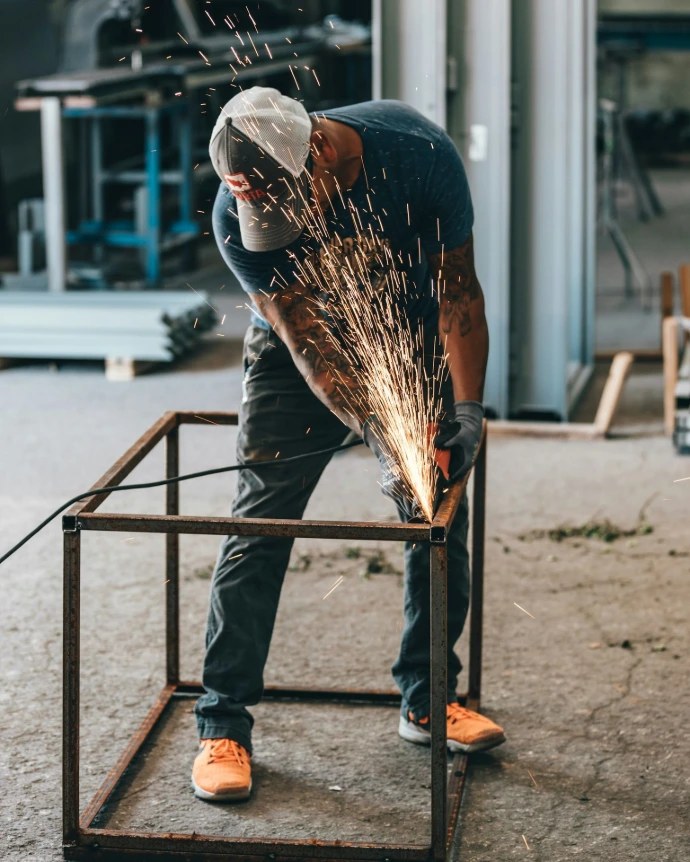
Metal fabrication is the work of turning flat sheet, plate, tube, and bar into a finished part or assembly by cutting, bending, joining, and finishing it. A wall bracket, a machine guard, a stainless counter, and a trailer toolbox are all fabricated parts.
It matters because almost every metal product you can't buy off a shelf is made this way, and each step adds cost, time, and tolerance. If you understand the sequence, you can draw parts that are cheaper to make and get quotes that don't come back full of questions. Below we walk through the four stages, how fabrication compares with machining and casting, and what pushes the price up.
What counts as fabrication
People use the word loosely. Some mean only welding. Others mean anything a sheet metal shop does. In practice, fabrication is the whole chain from raw sheet to a part you can bolt on, paint, and use.
A typical fabricated part goes through some or all of these:
- Cutting the flat shapes out of sheet or plate
- Forming those flats into 3D shapes, usually by bending on a press brake
- Joining the pieces into an assembly, by welding, bolting, or riveting
- Finishing the surface, by deburring, grinding, brushing, or coating
A single laser-cut gusset is still fabrication, just a short version of it. A welded and powder coated electrical kiosk uses all four stages.
The four stages, in the order they happen
Cutting
Most sheet metal parts start as a flat profile cut from a full sheet. Fibre lasers handle the bulk of thin and medium sheet work because they're accurate and leave a clean edge. Plasma is common on thicker plate where fine detail matters less. Waterjet turns up when heat would be a problem or the material isn't metal at all.
The cutting stage is where your DXF or STEP file becomes real, so file quality matters here more than anywhere. Our laser cutting page covers the materials we cut.
Forming
Bending turns a flat blank into a box, channel, angle, or bracket. On a CNC press brake, the operator programmes each bend angle and sequence, and the machine repeats it part after part. Bending rules (inside radius, minimum flange, hole distance from a bend) are where a lot of drawings go wrong, which is why we push people to check them before they quote.
Joining
This is the stage most people picture when they hear "fabrication": a welder fitting up parts and running beads. Welding gives a permanent, rigid joint. Bolts and rivets are the alternatives when you need to take something apart, or when heat would distort thin sheet. Our post on welding vs bolting vs riveting goes into how to choose.
Within welding there's a further choice of process. The two you'll hear about most are MIG and TIG, and the difference affects speed, appearance, and cost. See MIG vs TIG welding if the weld look matters on your part.
Finishing
Raw fabricated parts have sharp edges, weld spatter, heat tint, and sometimes oxide on laser-cut edges. Finishing cleans that up and protects the surface. That could be a simple deburr, a brushed finish on stainless, or a full powder coat in a RAL colour.
Fabrication vs machining vs casting
Fabrication isn't the only way to make a metal part. Here's where it fits.
| Fabrication | Machining | Casting | |
|---|---|---|---|
| Starts from | Sheet, plate, tube, bar | Solid block or bar | Molten metal in a mould |
| Best for | Enclosures, brackets, frames, panels | Precise solid parts, shafts, bores | Complex solid shapes in volume |
| Set-up cost | Low to moderate | Moderate | High (pattern or mould) |
| One-offs | Very practical | Practical | Rarely worth it |
| Material waste | Low, if parts are nested well | Can be high | Low |
| Typical weakness | Distortion from welding, bend tolerances | Slow for large parts | Lead time and tooling cost |
For a lot of real parts the answer is a mix: a fabricated frame with a few machined bosses welded in, for example.
What makes a fabricated part expensive
Fabrication is priced mostly on time, and material comes second for most small and medium parts. A few things add time fast.
- Number of separate pieces. Ten parts welded into one assembly means ten parts to cut, handle, fit, and tack. If two of them could be one bent part, you save a whole fit-up.
- Weld length and finish. A few tack-and-stitch welds on a hidden frame are quick. Continuous welds ground smooth for a visible stainless counter take much longer.
- Tight tolerances everywhere. Welding moves metal. If every dimension on the drawing is critical, the shop has to jig and check everything. Mark the dimensions that really matter and relax the rest.
- Awkward finishing. Masking threads before powder coating, grinding welds flush, or polishing inside corners all add labour.
- Material choice. Stainless and aluminium need more care to weld than mild steel, and cost more per kilogram.
Common examples of fabricated parts
Fabrication covers a wide range. A few typical jobs:
- Mounting brackets and base plates for equipment
- Machine guards and safety covers
- Electrical enclosures, kiosks, and control boxes
- Shopfitting frames, shelving, and display stands
- Trailer and bakkie toolboxes, canopy parts, and brackets
- Chute liners, hoppers, and bins in 3CR12 or stainless
- Signage frames, gates, and architectural screens
Some are one-offs, some are runs of hundreds. The process is the same; only the set-up and jigging change.
How to get a fabricated part quoted
Send as much of the picture as you have. For a fabricated assembly, that usually means:
- A 3D model (STEP) of the assembly, or an assembly drawing with a parts list
- The material and thickness of each part
- Which joints are welded, bolted, or riveted, and whether weld appearance matters
- The finish: raw, brushed, painted, or powder coated, with the colour
- Quantity, and whether you'll need repeats
If you're working from a sketch, that's fine too. Our guide to fabrication assembly drawings shows what a good drawing covers. When you're ready, read about our metal fabrication service or start a fabrication quote.