
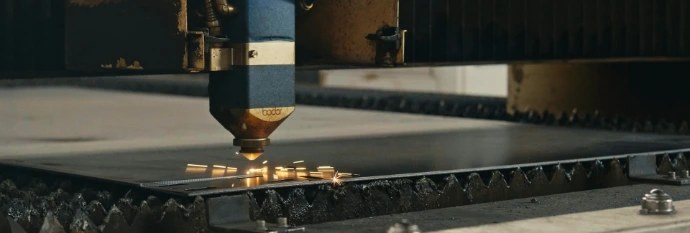
Laser cutting is a way of cutting flat metal by focusing a very powerful beam of light onto a tiny spot, melting the metal, and blowing the melt out with a jet of gas. A CNC machine moves the beam along the lines in your drawing, so the part comes out exactly the shape you drew, holes and all.
For you, that means no tooling to pay for, crisp detail, and the same price logic for one bracket as for five hundred. This post explains what's actually happening inside the machine, what laser cutting does well, where it struggles, and what you need to give a shop to get parts made.
How a laser cutter actually cuts metal
Strip away the sheet metal panels and a laser cutter is three things: a light source, a cutting head, and a flat bed the sheet lies on.
The source generates the beam. The head focuses it down to a spot a fraction of a millimetre wide, which concentrates the energy enough to melt steel almost instantly. A nozzle around the beam blows an assist gas straight down through the cut. That gas does real work: it pushes molten metal out of the bottom of the sheet so the cut stays open.
The machine first pierces a small hole to start each shape, then follows the outline. Every hole in the part, and every outer profile, needs its own pierce. Software decides the order so that small inside features are cut before the outer edge frees the part from the sheet.
Two assist gases are common:
- Oxygen on mild steel. It reacts with the hot steel and adds heat to the cut, which helps on thicker plate. It leaves a thin dark oxide layer on the edge.
- Nitrogen on stainless steel and aluminium (and on mild steel when a clean edge matters). It doesn't react, so the edge comes out bright and oxide-free.
That oxide layer matters later if the part is going to be painted or powder coated, which we cover in our post on laser cut edge quality.
Fibre lasers vs CO2 lasers
You'll hear both terms. The difference is the wavelength of light, and that changes which metals absorb it well.
| Fibre laser | CO2 laser | |
|---|---|---|
| Wavelength | About 1 micron | About 10.6 microns |
| How metals absorb it | Well, including aluminium | Less well, especially on reflective metals |
| Beam delivery | Through a flexible fibre-optic cable | Through a set of mirrors |
| Typical strength | Fast on thin and medium sheet, cuts aluminium and brass well | Long track record, still common on steel and on non-metals like acrylic and wood |
Most sheet metal shops that have bought a machine in recent years went fibre, mainly for speed on thin sheet and for how well it handles aluminium. For the customer, though, the label matters less than the result. Ask about the edge finish and accuracy you need, not the light source.
What laser cutting is good at
Laser cutting earns its place in a sheet metal shop for a few reasons.
Fine detail. The beam is narrow, so small holes, tight slots, lettering, and intricate patterns are all possible within sensible limits. A 2 mm mild steel bracket with a row of 3 mm holes and a slotted mounting tab is routine work.
No tooling. A punch press needs a punch for every hole shape. A laser just needs a file. That's why one-offs and prototypes are practical, and why a design change costs you an edit in CAD rather than a new tool.
Accuracy and repeatability. Laser-cut features in thin sheet are commonly quoted around ±0.1 mm in the industry. The fiftieth part matches the first. Our guide to laser cutting tolerances goes into what that number really means.
Clean edges. On thin sheet, especially stainless and aluminium cut with nitrogen, edges often need little more than a light deburr.
Efficient use of the sheet. Parts are nested close together on the sheet, which keeps scrap down. That feeds straight into your price.
Where laser cutting isn't the right tool
It's not the answer to everything, and a good shop will tell you so.
- Very thick plate. As thickness goes up, laser cutting slows down and the economics shift. On heavy plate where tight detail doesn't matter, plasma is often cheaper. Our comparison of laser cutting vs plasma cutting explains where the line usually falls.
- Heat-sensitive work. Laser is a thermal process. There's a small heat-affected zone along the cut. Usually that's irrelevant, but on some jobs it's not.
- Non-metals like glass, stone, and rubber. Those are waterjet territory.
- Holes smaller than the material thickness. A good starting rule is a hole diameter at least equal to the thickness. Smaller than that and the hole may not come out round or clean.
What materials can be laser cut?
In a sheet metal shop, the usual list is mild steel, stainless steel, aluminium, and 3CR12. Those are the four we work with.
Each behaves a bit differently. Mild steel cuts quickly with oxygen. Stainless cuts cleanly with nitrogen. Aluminium reflects more of the beam and conducts heat away fast, so it needs the right settings. 3CR12 cuts much like stainless.
Thickness limits depend on the machine's power and the material, so there's no single figure that applies everywhere. If your part is thick or unusual, put the thickness on the quote and ask.
Where laser cutting fits in a full job
For most parts, laser cutting is step one. A flat blank comes off the laser, and then it might be bent on a press brake, welded into an assembly, deburred, and powder coated.
That's why it pays to think about the whole route when you design the flat part. Holes too close to a bend line will stretch. Edges that will be coated may need cleaning first. Tabs and slots can make welding easier. If the part will be bent, a STEP model of the finished shape helps the shop check the flat pattern.
The kerf, the width of metal the beam removes, is handled by the shop's software, so you draw parts at their finished size.
Getting a part laser cut
You need four things: a drawing, the material, the thickness, and the quantity.
The drawing can be a DXF, DWG, STEP, or PDF, and a clear dimensioned sketch or photo is enough to start. If you're sending a DXF, our guide on how to prepare a DXF file for laser cutting will save you a round of questions.
Read more about our laser cutting service, or start a quote for laser cutting and add bending, fabrication, or powder coating to the same order.