
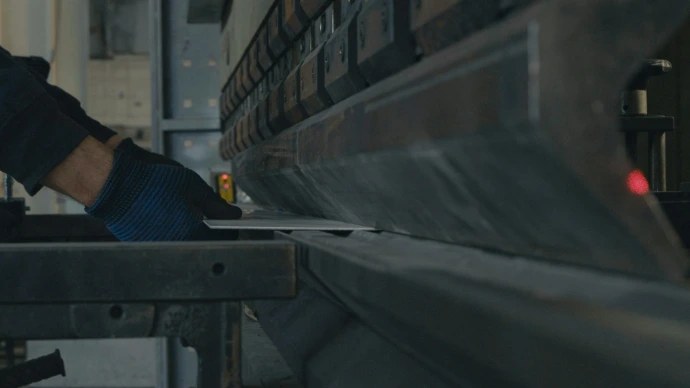
On 2 mm steel, don't draw a bent flange shorter than about 8 mm. The general rule of thumb is a minimum flange length of four times the material thickness, and some shops prefer 4T plus the bend radius for a bit of margin.
Short flanges are one of the most common reasons a drawing comes back with questions. The part looks fine in CAD, but on the press brake the flange simply drops into the die and the bend comes out crooked or not at all. Below is why the limit exists, a table you can design against, how to measure a flange properly, and what to do when you really need something shorter.
Why a flange can't be too short
Most sheet metal is air bent: the sheet lies across a V-shaped die, and a punch pushes it down into the groove. For that to work, the sheet has to rest on both shoulders of the die for the whole bend.
The die opening is usually about 6 to 8 times the material thickness. So on 2 mm sheet, the V is something like 12 to 16 mm wide. The flange has to reach past the centre of that V, over the shoulder, and keep sitting on it as the sheet rotates upward. If it's too short, the edge slips off the shoulder and into the groove halfway through the bend.
When that happens you get:
- A bend angle that's wrong and inconsistent from part to part
- A bend line that's wandered off where it should be
- Marks or a twist in the flange
A narrower die lets the shop bend a shorter flange, but narrower dies need more force and produce a tighter radius. There's only so far that trick goes, and it gets worse with thicker or stronger material.
Minimum flange length table
These are planning figures based on the 4T rule of thumb and typical die openings. They're a good starting point for design, not a promise from any particular shop. The "comfortable" column assumes an inside bend radius equal to thickness.
| Thickness | Typical V-die opening (6–8T) | Minimum flange (about 4T) | Comfortable flange (4T + R) |
|---|---|---|---|
| 1 mm | 6–8 mm | 4 mm | 5 mm |
| 1.5 mm | 9–12 mm | 6 mm | 7.5 mm |
| 2 mm | 12–16 mm | 8 mm | 10 mm |
| 3 mm | 18–24 mm | 12 mm | 15 mm |
| 4 mm | 24–32 mm | 16 mm | 20 mm |
| 6 mm | 36–48 mm | 24 mm | 30 mm |
Stainless and harder aluminium often need a larger radius, which pushes the comfortable figure up a little too. Our guide to sheet metal bend radius has starting radii by material.
My honest advice: design to the comfortable column whenever the part allows it. The minimum is the minimum. It's not where you want every flange to live.
How to measure the flange
This catches people out. The flange length in these rules is usually measured from the outside face of the bent part to the edge of the flange, the way you'd measure it with a tape after bending.
On a 2 mm part with a 2 mm inside radius, a flange dimensioned at 8 mm outside has only about 4 mm of straight metal beyond the curve. That's why the 4T + R version exists: it keeps a sensible straight section after the radius.
If you dimension to the inside face, add the thickness before you compare it with the table. And on the drawing, say which face you're measuring to.
Places where short flanges hide
The obvious flange is easy to check. These are the ones that slip through:
- Tapered or angled flanges. If a flange runs at an angle and gets shorter towards one end, it's the shortest point that counts.
- Notches and cut-outs near the bend. A slot cut into a flange can leave a short stub that's too small to bend properly. Keep cut-outs back from the bend line; our post on hole distance from a bend explains how far.
- Z-bends and offsets. Two bends close together in opposite directions form a step. The middle section between them is a flange too, and it has to sit on the die for the second bend. A tiny 3 mm joggle in 2 mm steel usually can't be done on standard tooling.
- Return flanges on channels. A U-channel with a small lip on each side is a common culprit. The lip has to meet the rule just like any other flange.
- Small tabs on enclosures. Fixing tabs on the edge of a box panel are often drawn very short to save space.
What to do if you need a shorter flange
Sometimes the design genuinely needs a stubby flange. You have options, in roughly this order of preference:
- Make it longer. Often the extra few millimetres don't matter to the function. Ask whether they really don't fit.
- Use thinner material. Dropping from 3 mm to 2 mm cuts the minimum from about 12 mm to 8 mm, if the part is still strong enough.
- Bend it long, then trim. The shop bends a longer flange and cuts it back after. This works, but it adds an extra operation and cost.
- Ask about tooling. Some shops have narrower dies or special tooling for short flanges in thin sheet. Ask before you design around it.
- Change the joint. A short flange that only exists to attach something might be better as a separate welded or bolted angle. That's a call worth making on cost and looks.
Flanges on enclosures and boxes
Boxes and enclosures put short flanges to the test, because every side folds up and space inside is tight. The lid lip, the mounting tabs, and the return flanges that stiffen the open edge all need to meet the rule.
It's also worth thinking about bend order. On a box, later bends happen with earlier flanges already standing up, and those flanges have to clear the tooling. Very deep boxes with short returns get awkward fast. Our guide to sheet metal enclosure design walks through this.
Sending your part
If you're unsure whether a flange is long enough, send it anyway and flag it in the notes. It's far cheaper to adjust a dimension at quote stage than after the blank is cut.
A STEP model of the bent part is the most useful file. A dimensioned PDF works too. Include material, thickness, bend radius (or "standard"), and quantity. Read more about our CNC bending service, or start a quote for CNC bending.