
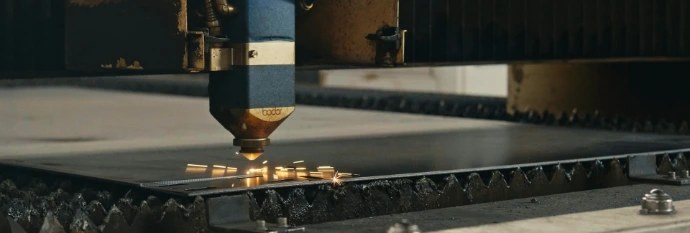
Laser cutting cost is mostly material plus machine time. The metal your part uses (and the scrap around it) is one half of the price; the minutes the laser spends piercing and cutting it, plus the time to set the job up, is the other.
You won't find a rate per metre here, because it isn't a useful number on its own. Two parts with the same outline can be priced very differently once thickness, hole count, and quantity come into it. What you can control is the design, and small changes there often move the price more than shopping around. Here's what each cost driver is, and what you can do about it.
The two halves of the price
When an estimator prices a laser-cut part, they're answering two questions.
How much sheet does it use? That's the part's own area plus its share of the gaps and offcuts around it on the sheet. Material type and thickness set the cost per square metre. 3 mm 304 stainless costs a good deal more per sheet than 3 mm mild steel, and a 6 mm sheet weighs twice what a 3 mm sheet does, with steel largely bought by weight.
How long is it on the machine? That's the total cut length divided by the cutting speed for that material and thickness, plus the time for every pierce, plus loading, unloading, and programming.
Everything else in this post is a detail of one of those two.
What makes machine time go up
Thickness
Thicker metal cuts slower. Much slower. A profile that flies through 1.5 mm sheet crawls through 10 mm plate, and the pierces take longer too. Thickness is usually the single biggest lever on cutting time, so don't specify 5 mm where 3 mm does the job.
Total cut length
Every millimetre of outline is a millimetre the head has to travel at cutting speed. Intricate edges, decorative patterns, and lots of internal cut-outs all add length. A plain 200 × 100 mm plate has 600 mm of cut. Put a fancy scalloped edge on it and that number can double.
Pierce count
Each hole, slot, and internal shape needs its own pierce before cutting can start. On thin sheet a pierce is quick. On thicker plate it takes noticeably longer. A perforated panel with 400 small holes can spend more time piercing than cutting.
Material and assist gas
Mild steel is often cut with oxygen. Stainless and aluminium are normally cut with nitrogen to keep the edge clean, and cutting with nitrogen on thicker material uses a lot of gas. That's part of why a stainless part can cost more than a mild steel part of the same size, beyond the price of the metal itself.
Setup and quantity
Every job has a fixed chunk of work before the first part is cut: checking the file, programming, nesting, loading the right sheet, and running a first part. On a single part, that setup is a large share of the price. Across fifty parts, it nearly disappears.
That's why a one-off often costs noticeably more per part than the same part in a batch of twenty. It's not a penalty, just the same setup spread over fewer pieces. If you know you'll need more later, ask for a price on a few quantities at once so you can see the curve.
How nesting and sheet usage affect your price
Parts are arranged on a standard sheet to waste as little as possible. A part that fits neatly gives a better yield than an awkward one with a big hole in the middle and a long arm sticking out.
Size matters here too. Common South African mild steel sheets are 2450 × 1225 mm and 3000 × 1500 mm. A panel that's just too big to fit two across the short side of a sheet can leave a strip of expensive offcut. Our guide to nesting sheet metal parts explains how shops lay out a sheet and what that means for your design.
Secondary operations
The laser is often just the first step. Everything after it adds to the price:
- Bending: each bend is a setup and a handling step. More bends, more cost.
- Deburring and edge cleaning: important for parts that will be handled or coated.
- Welding and assembly: usually the most labour-intensive part of a fabricated job.
- Powder coating: priced on size, colour, masking, and how many parts go through together.
- Tapping, countersinking, or inserts: small, but they add up across a big batch.
None of these are reasons to avoid them. Just be aware that a laser-cut blank and a finished, coated bracket are quite different prices.
How to bring the cost down
| Cost driver | Why it matters | What you can do |
|---|---|---|
| Thickness | Slower cutting, slower pierces, heavier sheet | Use the thinnest material that does the job; add a bend for stiffness instead |
| Material | Stainless and aluminium cost more to buy and cut | Use mild steel and powder coat where looks and corrosion allow, or price 3CR12 |
| Cut length | More length, more time | Simplify decorative edges; avoid detail nobody will see |
| Pierces | Each one adds time | Combine small holes into slots where it works; drop unneeded holes |
| Quantity | Setup spread over fewer parts | Order realistic batches; ask for prices at two or three quantities |
| Sheet yield | Awkward shapes waste metal | Keep parts compact; check overall size against standard sheets |
| Secondary ops | Each adds handling and labour | Design out unnecessary bends, welds, and masking |
Run through a sheet metal design checklist before you send drawings. It catches the expensive mistakes while they're still free to fix.
What to put on the quote
A quote is only as accurate as the information behind it. To get a firm price the first time, include:
- The drawing (DXF, DWG, STEP, PDF, or a photo with dimensions)
- Material and thickness, or "not sure" with a description of what the part does
- Quantity, and any likely future quantities
- Bends, welding, and finish required
- Anything critical: tolerances, show faces, colour
Our guide on how to get an accurate sheet metal quote covers this in more depth. When you're ready, start a quote for laser cutting or see what our laser cutting service covers.